What Is Bucket Budgeting? The Method, Step by Step
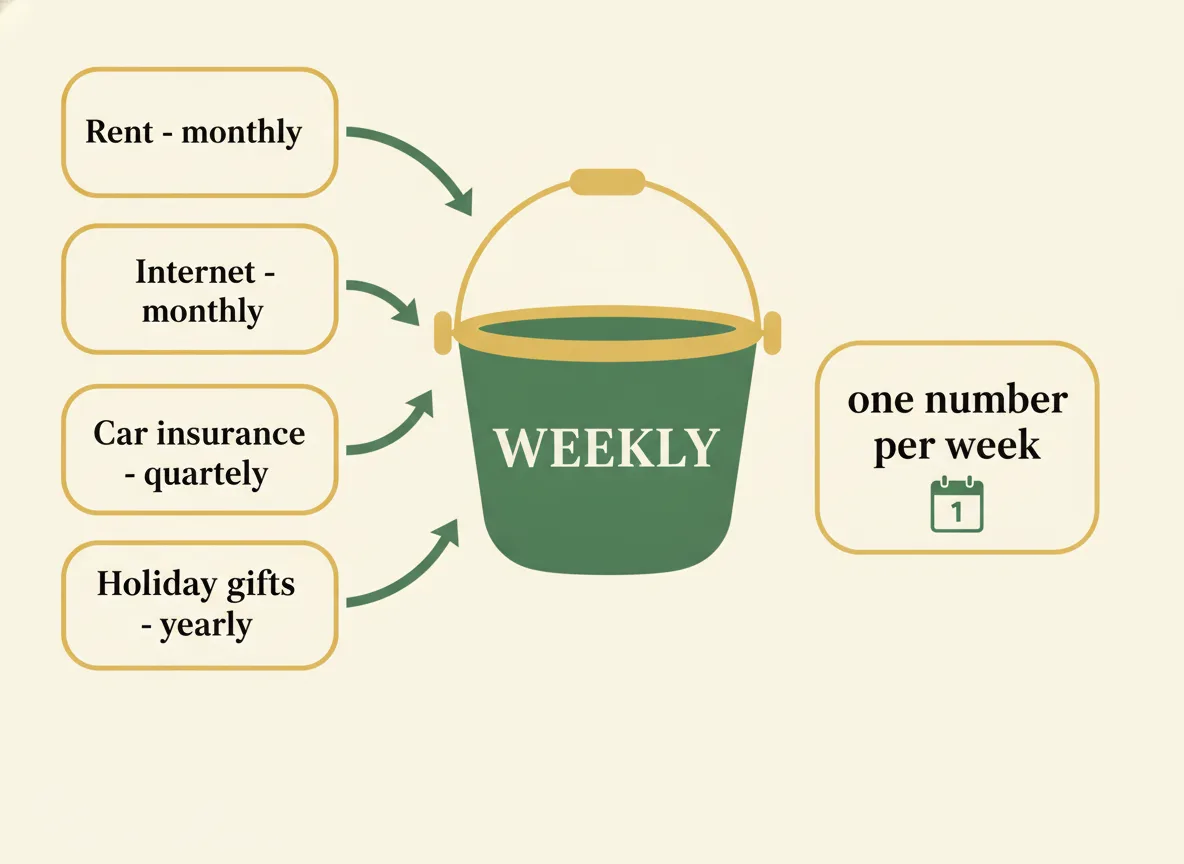
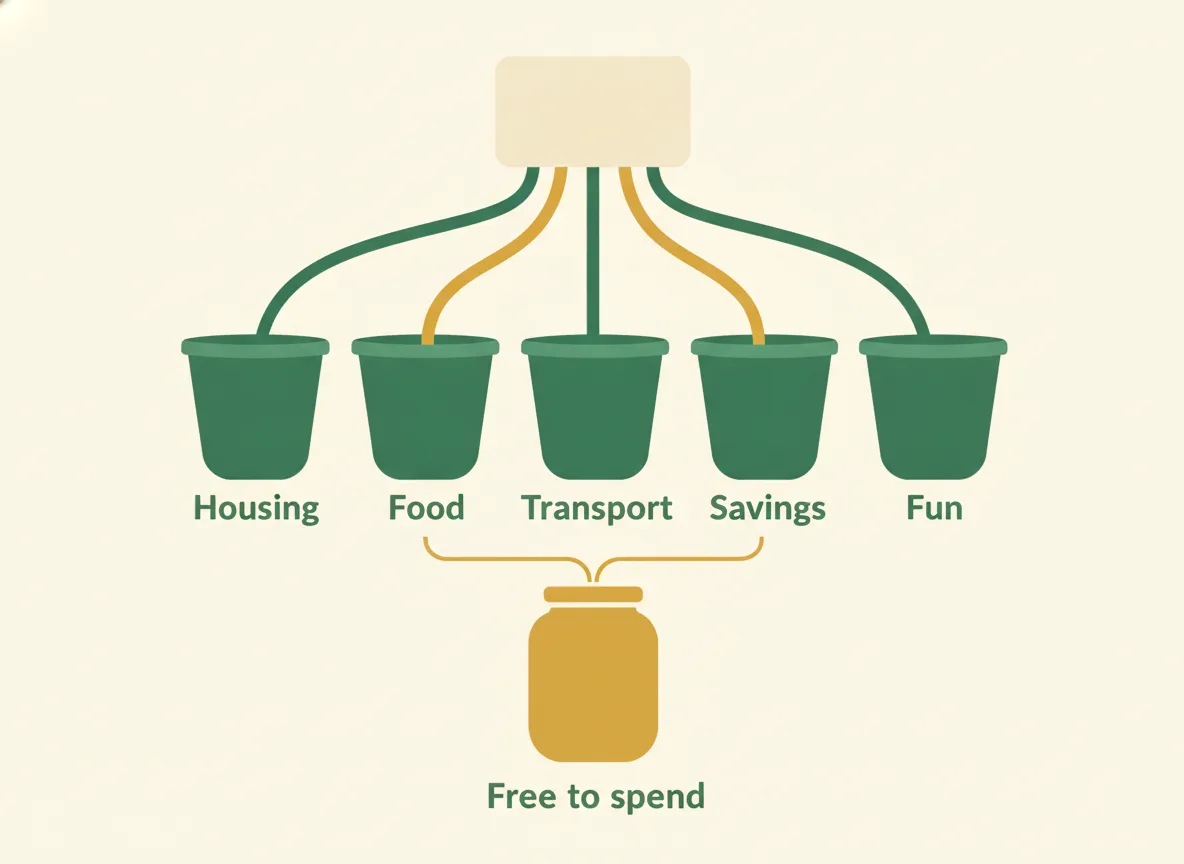
Bucket budgeting is a way of splitting your money into named buckets, one for each bill, goal or spending area, and giving each a small regular amount. A yearly insurance premium and a weekly grocery run end up on the same scale, so you can add them up and compare the total with your income.
The idea in one paragraph
Most budgets fail at the same point: the bills that do not arrive monthly. A bucket budget solves that by treating every cost as a rhythm. A yearly bill is a little each week. A quarterly bill is a little each paycheck. A monthly bill is a slice of every paycheck. When all of them are expressed per week or per paycheck, you can total them, subtract the total from income, and see what is left.
How it differs from other methods
Bucket budgeting borrows from several familiar methods:
- From envelope budgeting: each category has its own pot and a limit. See envelope budgeting.
- From sinking funds: costs that arrive rarely are saved for in advance. See what are sinking funds.
- From zero-based budgeting: the plan accounts for all income. See zero-based budget vs bucket budget.
The new element is the conversion to a common period. That is what lets you compare a weekly grocery cost with a yearly vehicle registration.
The steps
1. Know your income and how often you are paid
Write down your take-home pay and your pay schedule: weekly (52 paychecks a year), biweekly (26), semi-monthly (24) or monthly (12). If you have more than one source, list each one.
2. List your buckets
Write every bill, goal and spending area. Group them into broad categories to keep the list readable. Include savings and debt payments as buckets of their own. A list of ideas is in the budget categories list.
3. Give each bucket an amount and a frequency
For each bucket, note how much it costs and how often: "Rent, 1,300, monthly", "Car registration, 150, yearly", "Groceries, 120, weekly".
4. Convert to a common period
Multiply to get a yearly figure, then divide by 52 for a weekly amount or by your number of paychecks for a per-paycheck amount:
| Cost | Yearly | Per week | Per biweekly paycheck |
|---|---|---|---|
| Groceries, 120 weekly | 6,240 | 120.00 | 240.00 |
| Rent, 1,300 monthly | 15,600 | 300.00 | 600.00 |
| Insurance, 600 quarterly | 2,400 | 46.15 | 92.31 |
| Registration, 150 yearly | 150 | 2.88 | 5.77 |
5. Add them up and compare with income
Add up every bucket's per-paycheck amount. Subtract from your paycheck. If the number is positive, you have money left to assign or spend. If negative, you need to trim a bucket or raise income.
6. Fund the buckets on payday
On each payday, move or mentally reserve the amounts. Pay the bills that are due. Let the rest accumulate toward future bills.
7. Check and adjust
Once a month, compare what you planned with what you spent. If a bucket keeps running over, change its amount instead of hoping the next month will be different.
A small example
Here is a household with a biweekly take-home pay of 2,000:
| Bucket | Per paycheck |
|---|---|
| Rent | 600 |
| Utilities and phone | 170 |
| Groceries | 240 |
| Transportation | 160 |
| Insurance | 92 |
| Annual and seasonal costs | 110 |
| Debt payments | 200 |
| Savings | 160 |
| Spending money | 180 |
| Total | 1,912 |
| Left to assign | 88 |
The left-over 88 can go to a bucket, becoming a zero-based plan, or stay as flexible money. The numbers are only for illustration.
Benefits and limits
| Benefits | Limits |
|---|---|
| Yearly bills stop being surprises | It needs a first session to list everything |
| Every cost is on the same scale | Estimates for variable costs are guesses until tracked |
| You see the effect of changing one bucket | Cash-flow timing still matters: a bill due before your next paycheck needs money already set aside |
| Works for any pay schedule | Requires a monthly check to stay accurate |
Do buckets need separate accounts?
No. Many people track buckets in a spreadsheet and keep the money in one or two accounts. Others open separate savings accounts or sub-accounts for the larger buckets, such as a car or travel fund. Either way, what matters is that each bucket has a name, an amount and a balance you can see.
Who bucket budgeting suits
The method is not for everyone, but it tends to help in a few situations:
- You are paid weekly or biweekly, so monthly categories never match your paydays.
- Yearly and quarterly bills keep surprising you, and you want them folded into the regular plan.
- You like to see where each amount goes, with one name and one number per bucket.
- You share a budget with a partner, and want each shared bucket to be visible. The budget template for couples shows one way to do that.
It may be more than you need if your income is steady, your bills are few and you already have a plan that works. A method is only useful if you keep using it.
Common mistakes
- Too many buckets. Thirty buckets are hard to maintain. Start with ten to fifteen and merge small ones.
- Forgetting the yearly costs. They are the point of the method.
- Setting amounts too tight. Leave a little slack in variable buckets such as groceries.
- Never reviewing. Amounts drift. A monthly check keeps them honest.
Tools: using Bucket Budget Planner
Bucket Budget Planner is built around this method. On the Setup tab you choose your pay schedule and list your income. On the Buckets tab you add each bucket with an amount and a frequency from a dropdown, and the sheet fills in the weekly, per-paycheck, monthly and yearly amounts. The Dashboard totals everything and charts where the money goes. A library of 154 common US buckets gives you a place to start, and the Monthly Tracker tabs let you compare planned and actual spending.
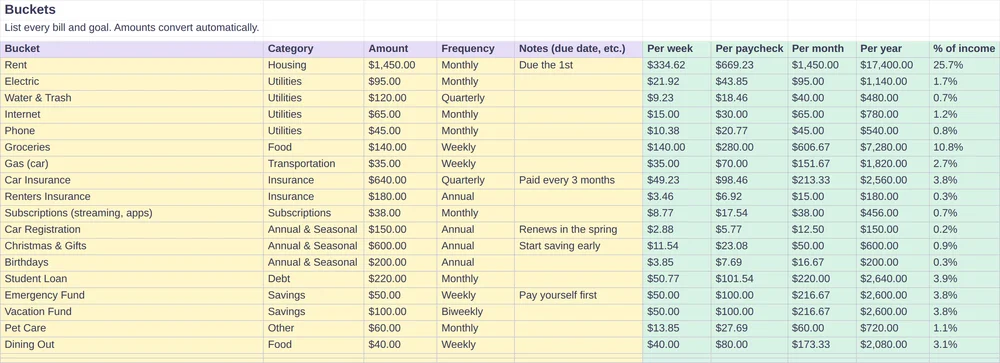
The included web app adds a Sinking Funds Calculator, an Annual Bills Calendar, a Paycheck Splitter that shows which bills each paycheck covers, and a Savings Goal Tracker.
For the step-by-step method that works with any budgeting style, see how to budget a paycheck.
This guide is general information, not financial advice.