How to Track Your Spending: Find Out Where Your Money Goes
To track your spending, record every purchase with a date, amount and category, then total each category at the end of the week or month. The method matters less than the repetition. Below are five approaches, how to pick one and a 15-minute routine that keeps the habit small.
Why "where does my money go" is hard to answer
Money leaves through many small channels: card taps, subscriptions, online orders, cash, automatic payments. Each looks harmless, and the total does not announce itself. Tracking turns scattered payments into a short list of categories you can read in one glance, which is usually where the surprise is.
Five ways to track
1. Statement review
Download last month's bank and card statements and mark each line with a category. No new habit needed, only an hour. Good for a first look, though it tells you about the past only.
2. Notes on your phone
Type each purchase when it happens. Quick, but totals need adding later and categories may be inconsistent.
3. Envelope or cash method
For categories like groceries or dining out, withdraw a set amount of cash and spend only that. Easy to see, but it does not cover card payments or bills.
4. Budgeting app
Apps import transactions automatically. Convenient, though many charge a monthly fee and keep your history inside their service.
5. Spreadsheet
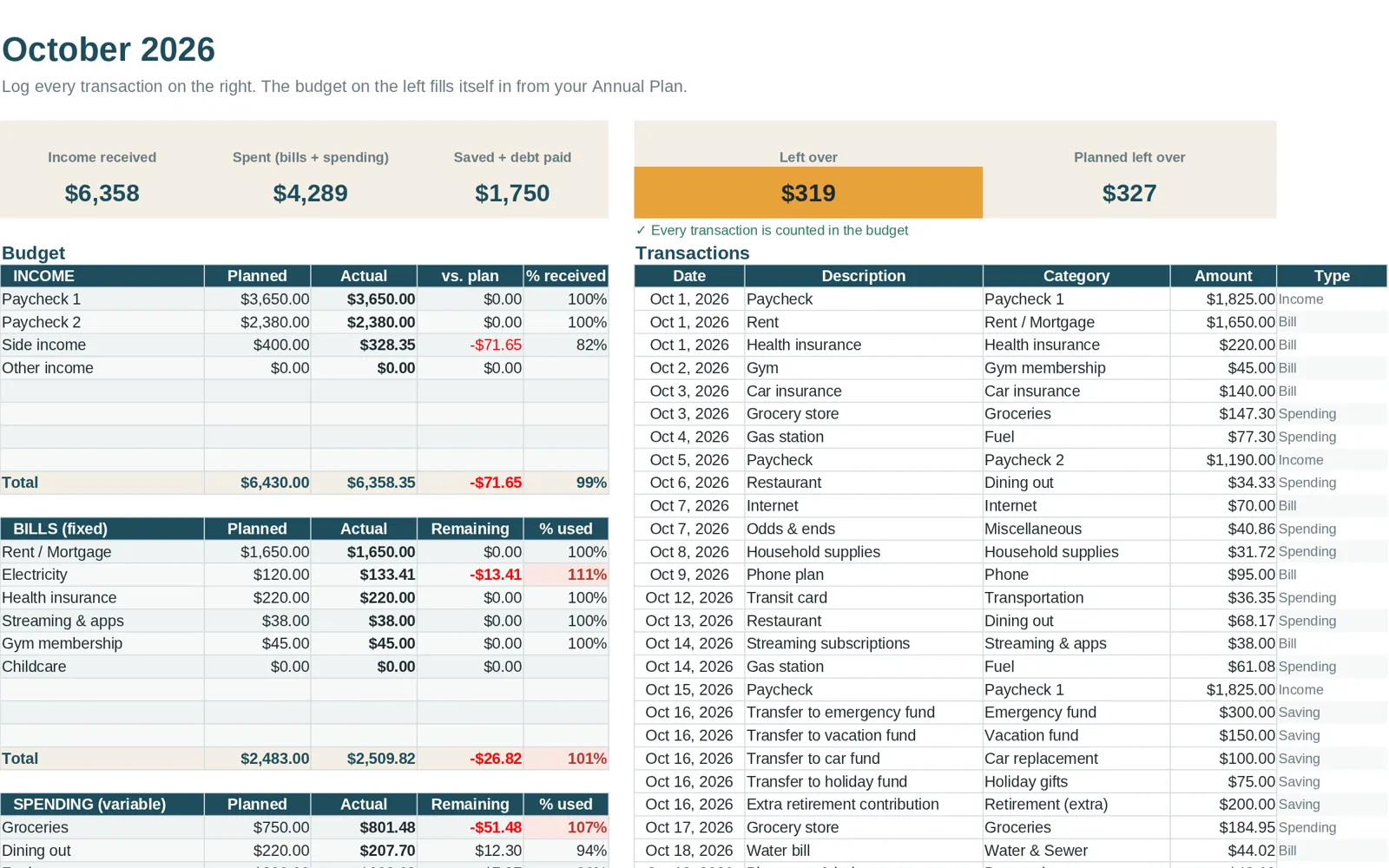
You enter or paste transactions into a log and formulas total each category. It takes a little effort, you control everything and there is no subscription. Many people pair it with a weekly session.
| Method | Effort | Cost | Control |
|---|---|---|---|
| Statement review | Low, occasional | None | Medium |
| Phone notes | Medium, daily | None | Low |
| Cash envelopes | Medium | None | Medium |
| App | Low | Often a subscription | Low |
| Spreadsheet | Medium, weekly | One-time or none | High |
A 15-minute weekly routine
- Choose a time. The same day each week.
- Pull the week's transactions. From your bank and card activity.
- Enter them in your log. Date, amount, category, a short note.
- Add cash purchases. From memory or your notes.
- Check each category against your plan. Mark any close to the limit.
- Make one decision. Move money, pause a purchase or leave it.
Skip nothing on step 3. The log is the source of truth.
Choose categories you can live with
Too few categories hide information; too many make logging slow. A workable list:
- Housing, utilities, insurance
- Groceries, dining out
- Transportation
- Health
- Kids or pets
- Subscriptions
- Shopping and household
- Fun and personal
- Gifts and holidays
- Savings and debt payments
If "shopping" turns out to be large, split it later. Do not start with forty lines.
What to look for in the results
After a month or two, read your totals by category and ask:
- Which three categories are the largest? Do they match your priorities?
- Which category surprised you?
- How many small recurring charges do you pay for that you rarely use?
- How much did you spend on convenience, such as delivery or last-minute purchases?
Often one or two categories explain most of the gap between income and savings. You do not need to cut everywhere; you need to look at the right place.
Common problems
- Falling behind. Do a shorter session next week and catch up; do not abandon the log.
- Mixed categories. Pick the dominant category for a purchase and move on.
- Shared accounts. Agree who logs and when; see how couples use a shared file in the monthly budget template guide.
- Bills lost in the log. Keep them in a separate list. The bill tracker guide shows how.
A spreadsheet already set up for it
Clear Budget Planner has twelve monthly tabs for January to December, each with room for up to 150 transactions, categories tied to the Annual Plan and plan versus actual worked out for you. The Dashboard and Year Summary show where the money went across the year. A blank and a filled-in example workbook are included, plus a Getting Started guide for Google Sheets or Excel.
If you would rather build your own, how to make a budget spreadsheet shows the steps. Once tracking becomes routine, the next challenge is staying on plan; how to stick to a budget covers it.