How to Calculate Your Net Worth, Step by Step
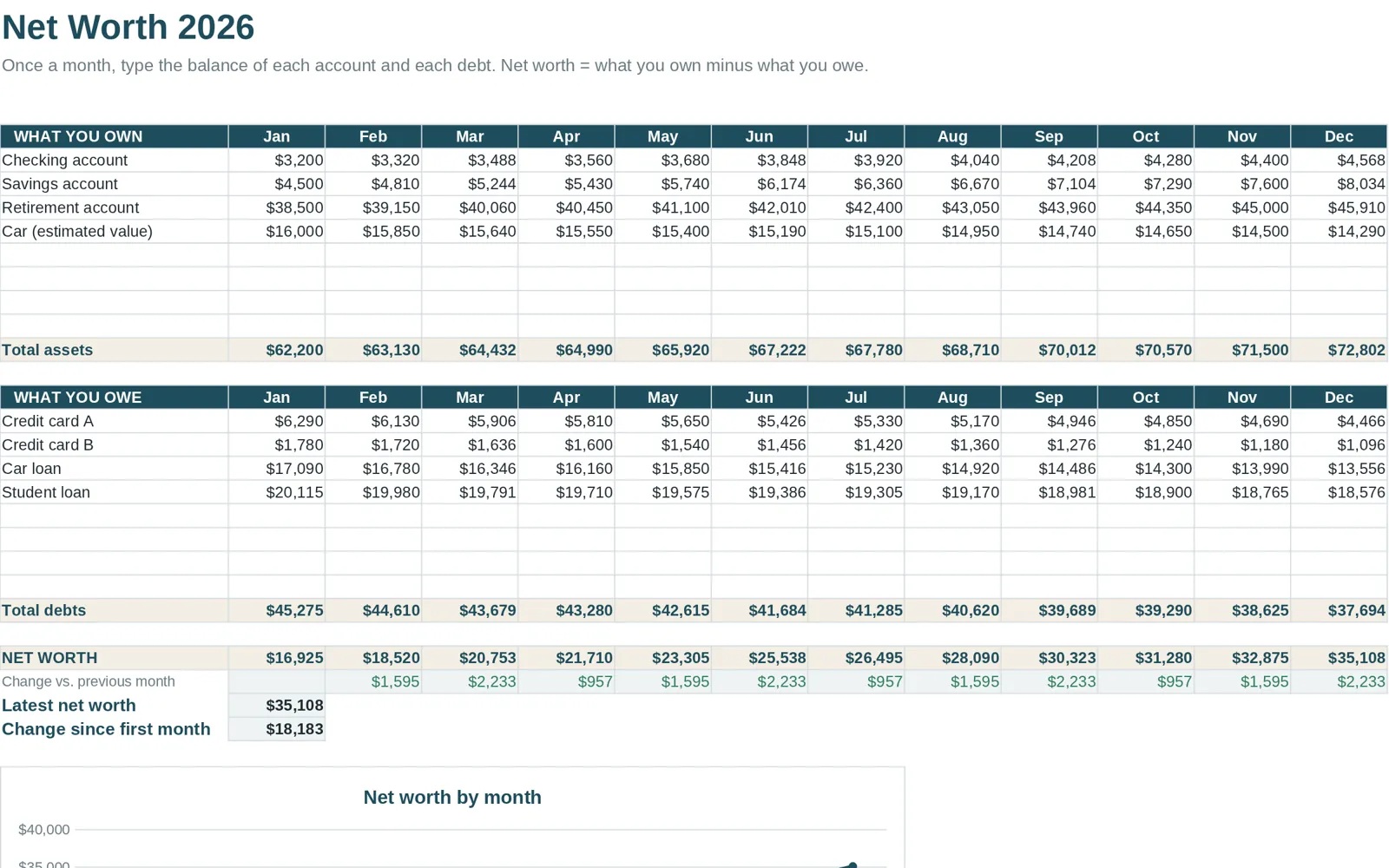
Your net worth is everything you own minus everything you owe. To calculate it, list your assets with their current values, list your liabilities with their current balances, and subtract the second total from the first. The result can be positive or negative, and the point is not the number itself but the direction it moves over time.
The formula
Net worth = total assets − total liabilities
That is the whole calculation. The work is in collecting accurate figures. Set aside about an hour for the first time; after that, updates take a few minutes.
Step 1: List your assets
Assets are things you own that have a monetary value. Group them so you can see the mix.
| Group | Examples | What number to use |
|---|---|---|
| Cash | Checking, savings, cash on hand | Current balance |
| Investments | Brokerage accounts, retirement accounts, other investments | Current account value |
| Property | Home, land | Estimated market value |
| Vehicles | Car, motorcycle, boat | Estimated resale value |
| Other | Valuable items you could sell | Estimated resale value |
Use realistic numbers. For a home, check recent sales of similar homes nearby or an appraisal. For a car, check listings for the same model, year and condition. When unsure, round down, not up.
What to leave out
Ordinary household goods such as furniture, clothes and small electronics are usually left off because they sell for little. Some people include them, which is a personal choice; the key is to be consistent every time you calculate.
Step 2: List your liabilities
Liabilities are what you owe. Use the current balance, not the original amount.
- Mortgage and home equity loans
- Car loans and leases with an outstanding balance
- Student loans
- Credit card balances
- Personal loans and buy-now-pay-later balances
- Medical or other bills you owe
- Money borrowed from family or friends
- Taxes owed
Look at your latest statements for each. If a balance changes daily, such as a credit card, use the statement balance or today's balance, and say which in your notes.
Step 3: Subtract
Add up the asset values. Add up the liability balances. Subtract.
A small illustration with made-up round numbers: if your assets total 60,000 and your liabilities total 45,000, your net worth is 15,000. If those figures were reversed, your net worth would be negative 15,000. These are not benchmarks and do not mean anything about what you should have.
Step 4: Repeat on a schedule
One calculation is a snapshot. The value comes from repeating it. Choose a day each month or each quarter, update every figure and record the new net worth. Over a year you will see whether it is rising, flat or falling, and why.
What moves your net worth
Four forces change the number:
- Saving: adding to cash or investments raises assets.
- Paying down debt: lowers liabilities.
- Value changes: investments and property can rise or fall in value.
- New borrowing or spending from savings: the reverse of 1 and 2.
Of these, saving and paying down debt are the ones you control. Market moves can swing your number in a month, so do not read too much into one reading. To work on the controllable part, see budgeting for beginners, which covers how to find money for saving and debt payments.
Common mistakes
- Using the purchase price rather than the current value. Values change.
- Forgetting debts. Small balances still count.
- Counting retirement accounts without noting taxes or penalties. Some people show them in full, others note a lower figure. Choose a method and stick with it.
- Mixing up equity and value. If you own a home with a mortgage, list the home at its value and the mortgage as a liability, or list only the equity, but do not do both.
- Checking too often. Weekly net worth tracking mostly measures noise.
- Comparing yourself with others. Your situation, age and obligations are your own.
How to read the result
Do not judge a single number. A negative net worth at the start of adult life, for example with student loans and little savings, is common and can improve steadily as debts shrink. A positive number can still be falling if spending is high. What matters is the trend across several months and whether the pieces you control, saving and debt payments, are moving the right way.
Write one sentence each time you update: what changed and why. After six months those sentences tell you more than the figures do.
Net worth and your yearly plan
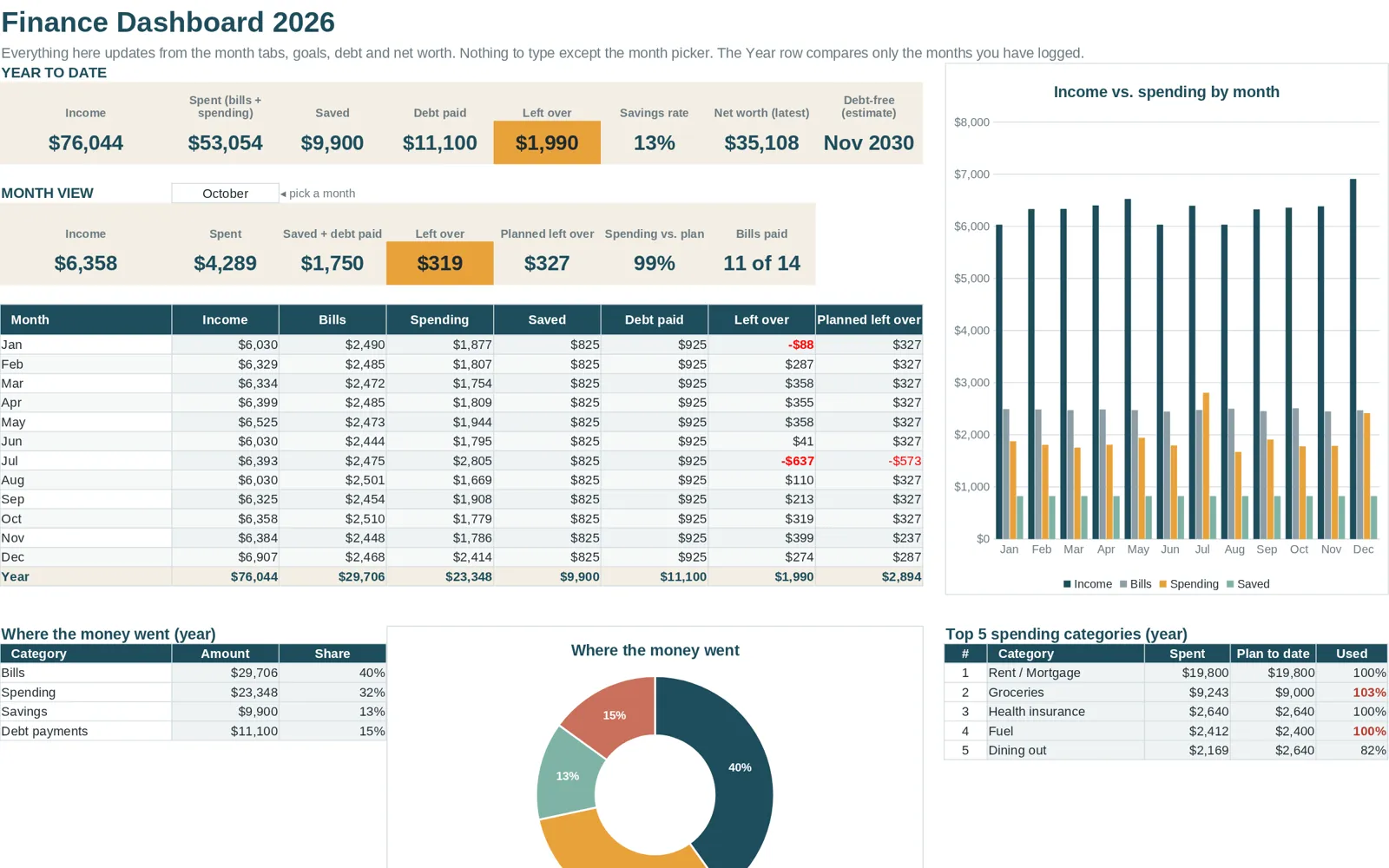
Net worth connects to your budget through two channels: what you save and what you pay toward debt. A yearly budget shows planned amounts for both. See the yearly budget template guide for how to set them. Seeing a rising net worth is also a good way to stay motivated when day-to-day budgeting feels dull.
Where to record it
You can write the figures on paper, in a notes app or in a spreadsheet. A spreadsheet adds up automatically and keeps a history, which lets you see the trend. For a layout, read the net worth tracker spreadsheet guide.
Clear Budget Planner has a Net Worth tab in its 21-tab workbook for Google Sheets and Excel. You update your assets and liabilities each month, and it totals them so you can watch the number over time. It sits next to the Debt Payoff tab, which lets you switch between the Snowball and Avalanche methods and shows a payoff date and total interest.
This page is general information for organizing your finances. It is not investment, tax or financial advice, and a licensed professional can help with decisions about your own situation.